Want to Invest in Property?
Let us help you make the right decisions for the best results.


Let us help you make the right decisions for the best results.
Housing affordability is a perennial fixture of the property debate, and governments are always looking for levers to pull – whether that means assisting buyers with incentives or stimulating supply on the developer side.
Both approaches have merit. But the Victorian State Government’s latest initiative, the Activity Centres program, is firmly focused on supply: creating more housing within established, well-serviced locations rather than continuing Melbourne’s relentless urban sprawl.
The stated ambition is to build 300,000 new homes by 2051 around roughly 60 train and tram activity centres across Melbourne. It’s a significant undertaking with significant implications for property investors. So let’s apply a SWOT analysis to assess whether these centres represent opportunity, risk, or both.
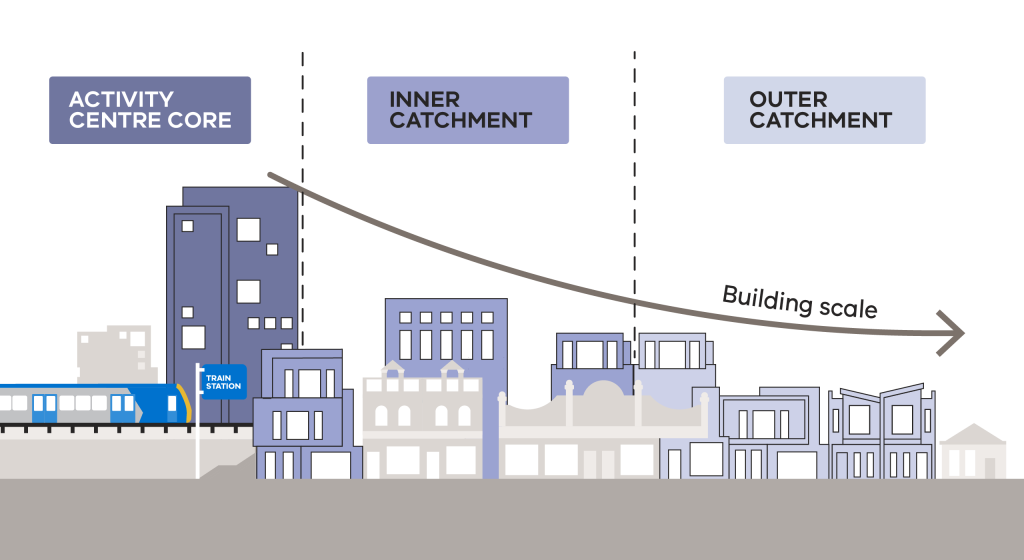
Image: Victorian Government
The core logic is sound. Melbourne has sprawled for decades, driven by abundant surrounding land that has made fringe development attractive for developers and lucrative for landowners when rezoning occurs. But the cost of that sprawl is borne by everyone: governments must extend train lines, build roads and fund schools in areas that lack existing infrastructure, while residents face punishing commutes and a work-life balance that becomes increasingly unsustainable the further out they go.
Focusing development around existing activity centres – places where people already shop, work, access public transport and connect with their community – leverages infrastructure that’s already in place. It’s easier and far cheaper to increase the frequency of trains on an existing line than to build an entirely new one. And the locations targeted are well-regarded and sought after for a reason: they offer employment opportunities, amenity and convenient access to the city.
The most obvious constraint is land availability. In established suburbs, land is at a premium. The government’s response has been to change planning regulations to allow greater density – lifting height limits from two storeys to three in some suburban areas, and permitting six to eight storeys closer to activity centres. But density alone is not the answer.
More attention should be given to change-of-use opportunities for existing land. Converting industrial or commercial land to residential use could unlock different construction types beyond high-density apartment towers – subject, of course, to appropriate environmental considerations.
Light industrial sites in inner suburban locations, for example, are increasingly poorly suited to their current use given the difficulty of moving trucks through congested urban streets. Rezoning these to residential opens up a wider range of housing forms.
The other significant weakness is infrastructure capacity. When people talk about infrastructure, they tend to focus on public transport. But the reality is broader: it’s roadways, schools, public open space and shopping facilities. Anyone who has driven around Melbourne recently knows how severe traffic congestion already is. Bringing more residents into tightly built areas will only exacerbate the problem.
The aspiration that proximity to public transport will reduce car dependency has limits – there will inevitably be an increase in vehicle use alongside any population uplift. The existing services in these locations were not designed for significantly larger populations, and upgrading them will take time and investment that needs to be factored into the planning.
From an affordability perspective – which is the government’s primary objective – increasing supply of similar property types in these locations should moderate price growth for that stock. If supply meets or even exceeds demand, prices plateau and housing becomes more accessible. That’s the intent, and it’s a reasonable one from a policy standpoint, even if it works against what investors typically want to see.
But the bigger opportunity lies in the government’s ability to dictate the type of property constructed, rather than simply chasing dwelling targets. If developers are left to build whatever maximises their returns, the default in these locations will be one and two-bedroom apartments. In suburban activity centres, that’s not what the market needs.
The target market, younger families in these areas are more likely to want larger three and four-bedroom apartments or townhouses. The government has a genuine opportunity to shape the product mix to match actual demand rather than developer preference.
There’s also the opportunity to identify highest-and-best-use for land that is no longer serving its original purpose well. Mixed-use, commercial and light industrial sites in suburban locations can be assessed and rezoned to residential where appropriate, creating more variety in what gets built and avoiding a monoculture of high-rise apartments.
The primary threat is that the wrong type of property gets built. If the focus is purely on hitting targets – 300,000 dwellings by 2051 – without sufficient regard for what’s actually wanted and needed, we end up with housing stock that doesn’t get taken up. Building for the sake of building serves no one.
In suburban locations especially, development needs to be targeted at the demographics most likely to live there: young families, first home buyers, couples and singles who are drawn to the amenity and connectivity these centres offer.
Every buyer wants property to be as affordable as possible at the point of purchase. But once they’ve bought, they need values to grow in order to build equity and take the next step up the property ladder. Significantly increasing supply and density in established areas risks undermining that for existing owners, as well as future owners in Activity Centres.
If existing residents feel that their property values and amenity are being sacrificed to hit government targets, community opposition will intensify. The government needs to bring existing owners along rather than alienating them in pursuit of numbers.
The Activity Centres program has genuine strengths. Focusing development around existing infrastructure rather than perpetuating urban sprawl is a logical and overdue shift. But the execution will determine whether it succeeds or simply creates new problems.
Done well – with the right product mix, adequate infrastructure investment, consideration of change-of-use opportunities and genuine engagement with existing communities – it could meaningfully improve housing affordability while maintaining the character and liveability of Melbourne’s established suburbs.
Done poorly, with a singular focus on dwelling numbers and developer-led construction, it risks building the wrong stock in the wrong way, while eroding value and amenity for those already there.
We’ll be tracking this policy closely in the years ahead. It’s a program with real potential – but only if the planning matches the ambition.
Listen to Jarrod’s podcast: